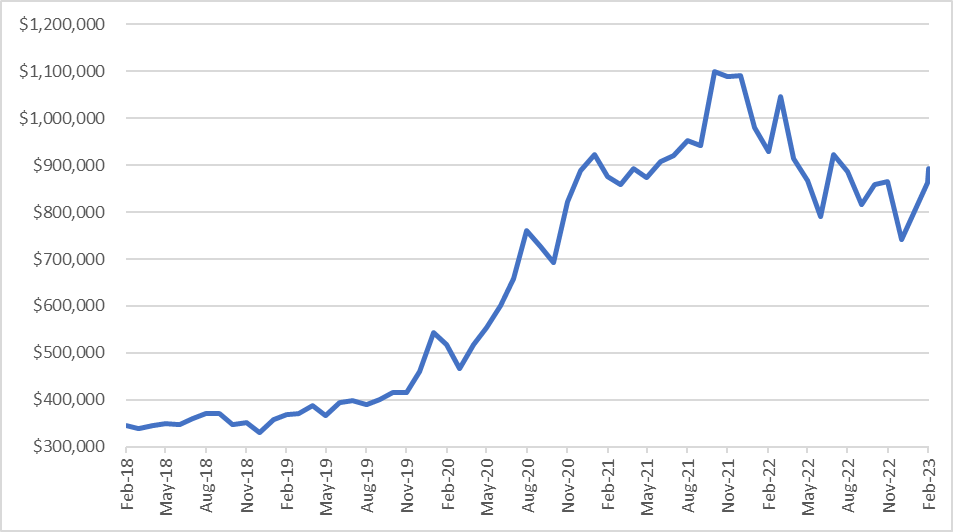
In January 2021, I became a millionaire. It was a bull market, everything was going up, and the gains felt inevitable. My retirement accounts were growing, the bitcoin I’d bought for $1,000 in 2016 was worth $150,000, and retirement was in sight. The market kept cooperating through the end of the year — net worth closed out at $1,255,000.
Then the Fed raised interest rates, and everything crumbled. Businesses had borrowed at rates so low that future profit expectations were inflated, and so were asset prices. The rate hikes were the pin that popped a decade-long bubble of near-zero-rate borrowing. Stocks dropped. Bitcoin dropped. Even real estate dropped, a little.
I also lost access to my entire cryptocurrency portfolio. Celsius, the platform where I held my crypto, paused withdrawals and filed for bankruptcy. I wasn’t too upset about the bitcoin — I’d only put in $1,000 and knew it was speculation — but I’d also put $20,000 of real money into USDC on Celsius because they were paying 10% interest when banks were paying 0.5%.
By the end of September 2022, my net worth was $867,000 — almost $400,000 down from the peak. That’s a lot, but it didn’t really bother me. I still had decades of working years ahead, plenty of time to recover. And the current value was still well above where I’d been three years earlier.

Two things kept me steady that year. I had a stable job the whole time, and I maxed out every retirement account I had access to — two Roth IRAs, a Roth 401k, and an HSA, about $40,000 total. Since the market was down, those contributions bought 20-30% more shares than they would have at the peak.
By November, the market was still down about 20% for the year, and I was getting more comfortable with the unrealized losses, not less. The only time you actually want the market to be up is when you’re ready to retire and start selling. You want it down as much as possible during your accumulation years, so your money buys more. I wasn’t retiring anytime soon, so lower prices just meant I could buy more.
Tesla was dropping hard that month too, mostly because of Elon Musk’s Twitter acquisition. I needed about 40 more shares to hit a goal I’d set — 1,200 shares between my wife’s and my portfolios — and it looked like the next year’s Roth contribution might get me there if the price dropped another $15 a share.
By January 2023, the market was up 6.2% for the month and Tesla was up 38%, adding about $116,000 to our portfolio in a single month.
By June, thanks to a strong recovery — inflation cooling, unemployment low, even the price of eggs coming back down at my local grocery store — my portfolio passed $1 million again. The S&P 500 was up 15% year to date and Tesla was up over 100%.

The lesson, for me, was simple: I didn’t change anything about how I invest during any of this. When the market dropped, I didn’t sell or shift my allocation. I kept contributing on schedule, at lower prices, all the way down and all the way back up. It pays to stay invested — the recovery happens fast, and it never announces itself in advance.
Update, July 2026: The Celsius bankruptcy finally resolved. I ended up recovering a significant chunk of what I’d lost — over $100,000 at current valuation. Took almost four years, but it worked out better than I expected at the time.